
Sherrod Brown and a Review of US Senators Holding Both Senate Seats
The tenure of fewer than two-dozen U.S. Senators includes service in each of their state’s seats during the direct election era
 Thanks to Smart Politics reader Brad K. for inquiring about this topic.
With Democrats looking to expand the 2026 map as large as possible to pry away enough GOP-held U.S. Senate seats to win back control of the chamber, one of the states they hope to flip is Ohio – where recently unseated Sherrod Brown is poised to face appointed incumbent Jon Husted.
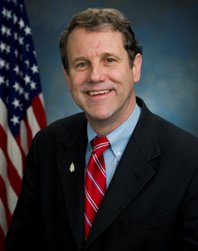
Brown, a former three-term U.S. Senator from the state’s Class I seat, is attempting to become the 23rd member of the chamber to serve in each of his state’s senate seats during the direct election era.
Over the last 223 years since statehood, four Ohioans have served in the U.S. Senate from both seats, with Democrat Howard Metzenbaum the only one to do so since the 1800s.
Metzenbaum was appointed to the Class III seat in January 1974 by Governor John Gilligan following the resignation of Republican William Saxbe to become U.S. Attorney General.
Metzenbaum then lost the Democratic primary that cycle to retired astronaut John Glenn but won his party’s nomination to the Class I seat in 1976 and returned to D.C. by unseating Robert Taft, Jr. in the general election in a rematch of the 1970 contest.
Three Ohio U.S. Senators served in both seats prior to the direct election era:
- Democratic-Republican Thomas Worthington: 1803-1807 (Class III) and 1810-1814 (Class I)
- Anti-Jacksonian / Whig Thomas Ewing: 1831-1837 (Class III) and 1850-1851 (Class I)
- Republican John Sherman: 1861-1877 (Class III) and 1881-1897 (Class I)
Arizona’s Jon Kyl was the most recent U.S. Senator to accomplish this feat across the nation following his appointment by Governor Doug Ducey in September 2018 to fill the vacancy after John McCain’s death. Kyl served four months in the Class III seat, having previously held office from 1995 to 2013 in the Class I seat.
Three other U.S. Senators served from both seats with at least one stint partially in the 21st Century:
- Washington Republican Slade Gorton: 1981-1987 (Class III) and 1989-2001 (Class I)
- North Dakota Democrat Kent Conrad: 1987-1992 (Class III) and 1992-2013 (Class I)
- New Jersey Democrat Frank Lautenberg: 1982-2001 (Class I) and 2003-2013 (Class II)
Brown would be the first U.S. Senator whose tenure in both seats fell entirely during the 21st Century.
Four states have had two U.S. Senators hold both seats during the direct election era.
Iowa:
- Republican Smith Brookhart: 1922-1926 (Class II) and 1927-1933 (Class III)
- Democrat Guy Gillette: 1936-1945 (Class III) and 1949-1955 (Class II)
Massachusetts:
- Democrat David Walsh: 1919-1925 (Class II) and 1926-1947 (Class I)
- Republican Henry Cabot Lodge, Jr.: 1937-1944 (Class II) and 1947-1953 (Class I)
New Jersey:
- Republican Warren Barbour: 1931-1937 (Class II) and 1938-1943 (Class I)
- Democrat Frank Lautenberg: 1982-2001 (Class I) and 2003-2013 (Class II)
West Virginia:
- Democrat Matthew Neely: 1923-1929 (Class I) and 1931-1941 (Class II)
- Republican Chapman Revercomb: 1943-1949 (Class II) and 1956-1959 (Class I)
The remaining U.S. Senators who represented their states from each seat are:
- Oklahoma Democrat Thomas Gore: 1907-1921 (Class III) and 1931-1937 (Class II)
- Delaware Republican T. Coleman du Pont: 1921-1922 (Class I) and 1925-1928 (Class II)
- Kentucky Democrat Alben Barkley: 1927-1949 (Class III) and 1955-1956 (Class II)
- Idaho Republican John Thomas: 1928-1933 (Class III) and 1940-1945 (Class II)
- Wyoming Democrat Joseph O’Mahoney: 1934-1953 (Class I) and 1954-1961 (Class II)
- Indiana Republican William Jenner: 1944-1945 (Class III) and 1947-1959 (Class I)
- Minnesota DFLer Hubert Humphrey: 1949-1964 (Class II) and 1971-1978 (Class I)
- Connecticut Republican William Purtell: 1952 (Class III) and 1953-1959 (Class I)
- Arizona Republican Barry Goldwater: 1953-1965 (Class I) and 1969-1987 (Class III)
- Texas Democrat William Blakley: 1957 (Class I) and 1961 (Class II)
The aforementioned North Dakotan Kent Conrad is of note because he moved from the state’s Class III to Class I seat in 1992 without a gap in service – unlike the other senators listed in this report.
Follow Smart Politics on X.
– Since the gubernatorial term was lengthened starting with the 1958 election, the state had elected different parties to those positions in 1962, 1970, 1974, and 2018 – with only 1970 voting D for governor and R for US senate. Despite that history, my surmise is that the Democrats are more likely to win the governor election than the more partisan Senate election should there be another split result.
– The tenures of both Barkley and Humphrey are notable because they were re-elected to the ‘other’ seats *after their respective tenures as vice presidents* – something more recent senators-turned-vice presidents had chosen not to do or will not do (anomalously, “Fritz” Mondale did make a bid, to the same seat in his case, in 2002 but narrowly lost).
– “Dollar Bill” Blakley is apparently the only senator not to have been directly elected to either of his state’s seats, though he did manage to be appointed by two different governors.
– Had his elected predecessor Quentin Northrup Burdick lived at least through early 1993 Conrad might well have been a one-term senator, one who would have been forgotten by now – and certainly not have wound up as a political trivia answer decades later on this blog.
It is curious that, through all of these attempted comebacks by U.S. senators, Metzenbaum remains the most recent one to run against a former colleague (that is, a senator in the state’s other seat he/she served concurrently with). As an appointed senator in 1974, Metzenbaum served alongside Robert A. Taft, Jr., and he defeated Taft Jr. for re-election in 1976.
There has been no shortage of potential candidates in this vein in recent years — for example, Mark Begich and Kay Hagan in 2016; and Joe Donnelly, Cory Gardner, and Dean Heller in 2022 — but all declined to run.
Jon Tester was a speculated candidate in 2026, presumed at the time to face his former colleague Steve Daines, but Tester declined to run even before Daines surprisingly announced his retirement on the filing deadline (effectively handing the seat to his chosen successor Kurt Alme).
Some previous examples:
*Massachusetts, 1926: former Sen. David I. Walsh (1919-25) defeats appointed incumbent Sen. William M. Butler (1924-26)
*West Virginia, 1930: former Sen. Matthew M. Neely (1923-29) defeats incumbent Sen. Guy D. Goff (1925-31)
*Massachusetts, 1946: former Sen. Henry Cabot Lodge, Jr. (1937-44) defeats incumbent Sen. David I. Walsh (1919-25 & 1926-47)
Some previous unsuccessful attempts:
*West Virginia, 1952: former Sen. Chapman Revercomb (1943-49) lost to incumbent Sen. Harley Kilgore (1941-56)
*Idaho, 1954: former Sen. Glen H. Taylor (1945-51) lost to incumbent Sen. Henry Dworshak (1946-49 & 1949-62)
*Florida, 1958: former Sen. Claude Pepper (1936-51) lost the primary to incumbent Sen. Spessard Holland (1946-71)
*Oregon, 1972: former Sen. Wayne Morse (1945-69) lost to incumbent Sen. Mark Hatfield (1967-97)
*Texas, 1972: former Sen. Ralph Yarborough (1957-71) was to face incumbent Sen. John Tower (1961-85) but lost the primary
One recent example is worth mentioning, but with an asterisk:
*New Hampshire, 2014: former Sen. Scott Brown (2010-13) lost to incumbent Sen. Jeanne Shaheen (2009-present), but of course they were colleagues from different states, not in-state colleagues.
If former Senator Brown were to win, he would also become one of very few senators who had been *directly elected, defeated, and re-elected* to the chamber, joining John Sherman Cooper (R-KY) and about a dozen others.
{There is a considerable overlap between 1) those who had occupied both seats in the direct election era and 2) those who had rebounded after having been elected and defeated at the ballot box. Should Brown triumph over Husted I may opt to return to this topic and catalog all of the ‘rebound US senators’.}
M M Neely also served from 1949-1958 (class 2), which was his third and final non-consecutive tenure. In between his second and third stints, he was elected governor in 1940 (resigning his Senate seat with two years remaining), elected to the House in 1944 after being term-limited, and lost re-election in 1946 in the Republican wave.
Neely apparently is the only West Virginian to have successfully traversed the US senate – governor – US House – US Senate route. Anyone else from another state?